

When he looked me in the eyes and spoke his words toward me, my body knew he was lying.
Heart arrhythmia. Rapid breathing. Muscles tense. My voice coming out in fragments. My mind searching for a way out.
A classic stress response: adrenaline and cortisol activating me physically.
A lie impacts the body both when it's told and when it's received. We know we're being lied to before we consciously "know" it.
My body collapsed and I cried. But my mind, trapped in the bond, wanted to save him. To give him another chance.
I chose to trust, even with the weight still on my chest.
A few hours later, by grace of fate, the truth appeared — cruel — right beside me.
And Wonder Woman came to save me.

Wonder Woman is the only superhero I've ever truly connected with. I identify with her in ways I can't always explain. I wear her emblem on my motorcycle, my jacket, my helmet. I even have a bikini with her name and the stars on it.
And you're going to love this story:
The pioneers in studying the physiology of lying were American psychologists William Moulton Marston and his wife Elizabeth.
In 1921 they developed the polygraph — the "truth machine" — based on changes in systolic blood pressure when we lie. That's the pressure created when the heart pushes blood through the body in response to adrenaline.
Here's the remarkable part: William Moulton Marston was also the creator of Wonder Woman.
In 1941, he designed a heroine with a weapon that doesn't kill or destroy — though it can hurt deeply: the Lasso of Truth.
The moment that golden lasso touches you, the truth is revealed without filter. The chain of lies we've been living in finally breaks — to free us and to set things right.
Wonder Woman saved me, at the last moment, from the last lie.
My own body had become the Lasso of Truth.
The racing heart, the muscle tension, the mind stunned by brutal reality. It was just my body screaming at me to finally listen.
Here's something worth knowing: the insula is a region of the brain whose job is to listen to and interpret signals from the heart, lungs, gut, and muscles.
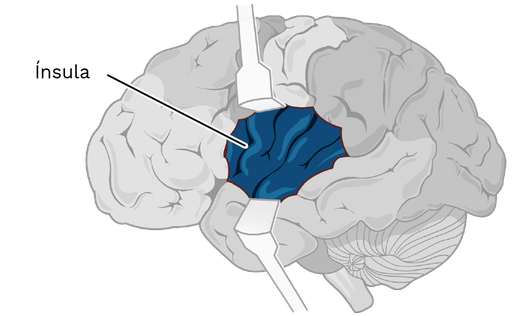
When something doesn't add up, the insula registers it as a physical sensation. It might be pressure in your chest, your throat, or your stomach.
Antonio Damasio called it the "somatic marker."
Simple, right? From now on, let's listen to our bodies more carefully.
But here's where it gets even more unsettling.
Rui Huang, researcher at the School of Psychology and Mental Health at Hebei University, published in November 2025:
When we love the person who is lying to us, our brains synchronize. That connection, that trust — that very synchrony — is exactly what shuts down our ability to detect the threat.
Because the brain regions linked to reward and emotional bonding activate and override the regions responsible for evaluating risk and danger.
And there's more. In February 2026, Giorgio Veneziani, psychologist at Sapienza University of Rome, added: Yes, during deception the brains synchronize — but the hearts decouple.
The central nervous system and the autonomic nervous system respond in opposite directions.
The receiver's heart perceives the lie that the brain doesn't want to register.
So neuroscience and Wonder Woman teach us the same thing: when a person is truly present in their body, the alarm signal is clear. The heart knows.
Then the mind arrives — to save us. Or to keep us chained.
I invite you to Build a Serenity Pause the next time something doesn't feel right.
Stop and notice what somatic marker has shown up in your body. And ask yourself honestly: are you avoiding the truth because breaking the emotional bond feels too costly?
Start by deactivating your body — place your Shoulders Away From Ears. The insula recalibrates, cortisol drops, and you can breathe and think again.
Remember: you're always wearing the Lasso of Truth.
Scientific sources for this newsletter:
· Marston, W.M. (1938). Emotions of Normal People. Routledge.
· Lepore, J. (2014). The Secret History of Wonder Woman. Knopf.
· Langleben, D. et al. (2002). NeuroImage, 15(3), 727–732. https://pubmed.ncbi.nlm.nih.gov/11848716/
· Damasio, A. (1996). Philosophical Transactions of the Royal Society, 351(1346). DOI: 10.1098/rstb.1996.0125
· Huang, R. et al. (2025). Journal of Neuroscience. DOI: 10.1523/JNEUROSCI.2129-24.2025
· Veneziani, G. et al. (2026). Annals of the New York Academy of Sciences. DOI: 10.1111/nyas.70217
Building a Serenity Pause is the simplest way to deactivate the physiological symptoms of the stress response. It's a proven method recommended by the European Agency for Safety and Health at Work.
Write to me and I'll tell you how.
If you're an organization and would like to work with me, reach me at +34 629 196 994 or maite@todoyoga.com
Join the S.A.F.E. movement — Shoulders Away From Ears — for a safer world. Want to know more? Send me a message. 😉